Welcome to the 58th Southwest Region Annual Meeting & Education Conference On-Demand Platform!
This page includes links to the Virtual Poster Hall and On-Demand Education Modules, available through March 31st. To view a poster or session, click anywhere on the image to the left of the title. To learn more about the speaker and presentation, click the “+” icon to review the presenter(s), bio, abstract, learning objectives, and disclosure statement.
After viewing the materials, please complete the evaluation form to receive your CE certificate. No CE certificates will be issued after March 31st, so please plan accordingly.
If you have any questions, contact Soror Lowryanne Vick, 2nd Assistant Regional Director, at 2ndard@swrchietaphi.org
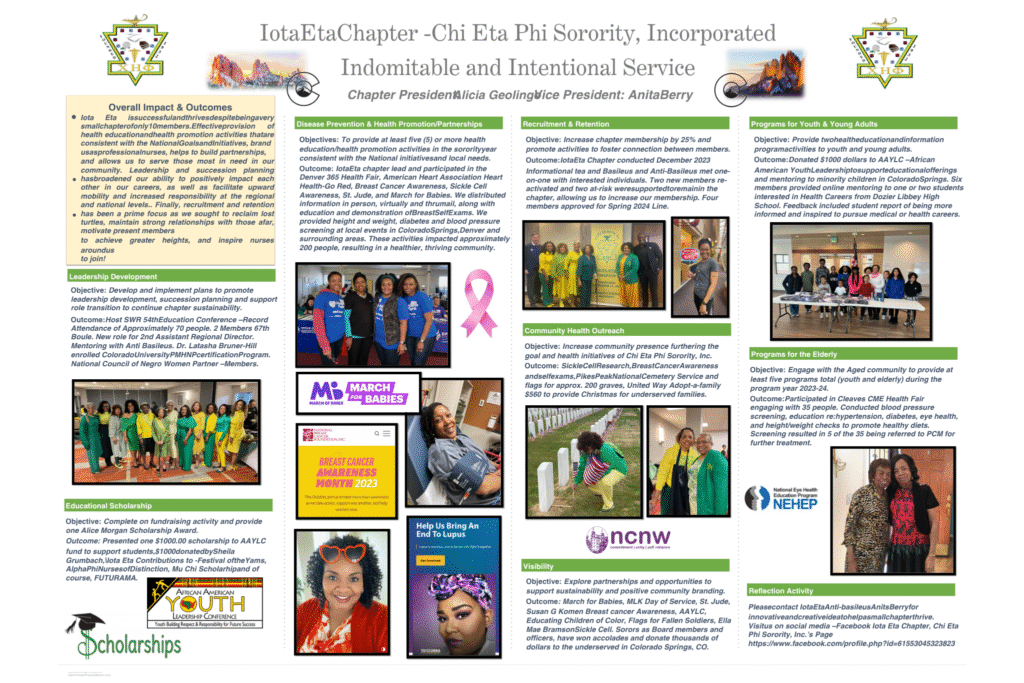
Virtual Poster Session
Multiple Presenters
Explore innovative projects, research, and quality improvement initiatives led by nurses and student nurses across the Southwest Region. Our virtual poster session highlights excellence in scholarship, leadership, and service — showcasing the impact of nursing beyond the bedside and within the communities we serve.
Title: Choosing the Best Diet for You: A Detailed Look at Science for Nutrition
Presenter: Martina Travis-Blount, BSN, MPH
Contact Hours: 1.00
Bio
Martina Travis-Blount, BSN, MPH, is a retired public health administrator dedicated to serving her community. She has extensive experience in public health nursing and management, including overseeing health services for Los Angeles County residents and developing county-wide policies. She holds an MPH from UCLA and a BSN from the University of Missouri. She is skilled in public health strategies, policy development, and management. An active member of Chi Eta Phi Sorority, she is passionate about health education, lifestyle changes, and chronic disease prevention.
Abstract & Learning Objectives
Learn how to choose a diet that fits your lifestyle and health goals. This course will cover multiple dietary approaches and provides guidance on creating eating habits for better overall wellness.
Upon completion of this module the learner will be able to:
- Identify types of diets.
- Understand the features of each diet.
- Identify the benefits of each diet.
Disclosure Statement
The Southwest Region of Chi Eta Phi Sorority, Incorporated is an approved provider of nursing continuing professional development by the Nevada State Board of Nursing, Provider Number: # NV-14137. Completion of this session will award 1.00 contact hour. As an attendee, to receive the nursing continuing professional development credits, you must remain for the entire presentation and submit the presentation evaluation form. The speaker(s) and the member(s) of the planning committee have declared no relevant relationships. This activity has no commercial support or sponsorship.
Title: Cultural Competence: Transcultural Self-Efficacy in Nursing & Public Health Students
Presenter: Patricia Burrell, PhD, APRN, BC, CNE, FTNSS
Contact Hours: 0.25
Bio
Patricia M. Burrell, PhD, APRN, BC, CNE, FTNSS, is a Professor of Nursing at Hawaii Pacific University and serves as Director of the Transcultural Nursing Center and Director of Research and Evaluation. She holds a Ph.D. in Transcultural/Psychosocial Nursing from the University of Utah, a Master of Science in Nursing in Mental Health/Psychiatric Nursing from the University of Hawaii, a Bachelor of Science in Nursing from Northeastern University, and a Diplomate in Analytical Psychology from the C.G. Jung Institute in Zurich, Switzerland.
Dr. Burrell is licensed as an RN and APRN and is board certified in Adult Mental Health/Psychiatric Nursing. She is also certified as a Nurse Educator. Her academic career includes leadership roles such as Chief Nurse Administrator, Chair of Graduate Nursing Programs, and Assistant Dean of Nursing. She maintains a private practice as a Jungian Analyst and Psychiatric/Mental Health APRN.
Her scholarship focuses on transcultural nursing, cultural competence, mental health, and nursing education. She has presented internationally, authored numerous publications, led funded research initiatives, and received multiple honors, including research awards and keynote recognitions at international nursing conferences. Dr. Burrell remains active in professional organizations including the Transcultural Nursing Society, the American Nurses Association, the National Black Nurses Association, Sigma Theta Tau, and Chi Eta Phi Sorority, Incorporated.
Abstract & Learning Objectives
Our nursing students and public health students work with and are conversant with the cultural practices of their clientele in the community. Cultural competence includes not only warmth, empathy and genuineness, but also policies and procedures focused on the populations being served. We used the TSET, The Transcultural Self-Efficacy Tool to look at our students’ Transcultural Self-Efficacy. The TSET is an 83 – item tool developed by Marianne Jeffries, based upon Bandura’s Theory of Self-Efficacy. It has three sub-scales; Cognitive, dealing with cultural knowledge; Practical, dealing with interviewing skills, and Affective, dealing with their attitudes, beliefs and values along with their capacity to Advocate for clients. Scoring High usually indicates overconfidence and a need for correction, Medium indicates competency, and Low indicates a need for work and focus. The Public Health students scored medium throughout. While surprisingly, the Nursing students scored High in the Affective and Advocacy scales. They scored Medium on the Cognitive and Practical scales. Nursing looked at correcting some of the overconfidence of our senior nursing students who had successfully been working with clients from many differing cultural groups throughout the program.
Upon completion of this module, the learner will be able to:
- Identify the three areas of competence in the TSET.
- Differentiate between high, medium and low in scoring.
- Identify three things that are listed as part of cultural competence.
Disclosure Statement
The Southwest Region of Chi Eta Phi Sorority, Incorporated is an approved provider of nursing continuing professional development by the Nevada State Board of Nursing, Provider Number: # NV-14137. Completion of this session will award 0.25 contact hours. As an attendee, to receive the nursing continuing professional development credits, you must remain for the entire presentation and submit the presentation evaluation form. The speaker(s) and the member(s) of the planning committee have declared no relevant relationships. This activity has no commercial support or sponsorship.
Title: Connected or Left Behind? Aging and the Digital Divide in Health Care
Presenter: Lowryanne Vick, DNP, APRN, ACNP-BC
Contact Hours: 1.00
Bio
Dr. Lowryanne Vick, DNP, APRN, ACNP-BC is a nationally recognized nurse leader, digital health scholar, and Doctor of Nursing Practice–prepared. As an Acute Care Nurse Practitioner, she has clinical experience in critical care, cardiology, internal medicine, and virtual care delivery. She currently serves as an Education & Implementation Specialist with the Veterans Health Administration (VHA) Office of Connected Care, where she leads national training and curriculum development initiatives, advancing competency-based telehealth education across the enterprise. She previously served as Chief of Telehealth Services at the VA Southern Nevada Healthcare System, where she expanded access to care for Veterans. Throughout her career, she has led interdisciplinary process improvement initiatives, implemented innovative clinical programs, and championed equitable access to care through technology.
Dr. Vick is deeply committed to nursing leadership and service. She serves as Vice President of the Eta Eta Eta Chapter of Chi Eta Phi Sorority, Incorporated, and as Second Assistant Regional Director for the Southwest Region.
Abstract & Learning Objectives
As healthcare delivery increasingly shifts toward virtual modalities, older adults risk being unintentionally excluded due to persistent assumptions about aging and technology use. Age-related bias, digital literacy gaps, sensory and cognitive changes, limited broadband access, and insufficient caregiver integration contribute to inequitable telehealth adoption. Yet evidence demonstrates that older adults can successfully engage in virtual care when provided structured support and age-inclusive design.
This presentation examines the intersection of aging, ageism, and the digital divide through a practice-based and evidence-informed lens. Drawing from current literature and real-world telehealth implementation within the Veterans Health Administration, participants will explore common barriers to telehealth utilization among older adults and identify actionable strategies to promote equitable access. Evidence-based approaches—including individualized digital readiness assessment, caregiver inclusion, accessible technology adaptations, broadband and device support, and workforce training—will be discussed.
Attendees will leave with practical, system-level and clinician-level interventions to reduce digital exclusion and ensure that older adults are not left behind in the evolving landscape of connected care.
Upon completion of this module, learners will be able to:
- Describe how age-related factors (e.g., sensory changes, cognitive load, health literacy, and technology experience) influence access to and use of digital health technologies among older adults.
- Identify key components of the digital divide affecting aging populations, including socioeconomic, cultural, and infrastructural barriers that impact equitable access to virtual care.
- Examine evidence-based strategies nurses can use to assess digital readiness and support older adults’ engagement with health technologies in clinical and community settings.
- Apply practical nursing interventions to reduce age-related digital barriers and promote safe, patient-centered, and equitable use of health technologies.
Disclosure Statement
The Southwest Region of Chi Eta Phi Sorority, Incorporated is an approved provider of nursing continuing professional development by the Nevada State Board of Nursing, Provider Number: # NV-14137. Completion of this session will award 1.00 contact hour. As an attendee, to receive the nursing continuing professional development credits, you must remain for the entire presentation and submit the presentation evaluation form. The speaker(s) and the member(s) of the planning committee have declared no relevant relationships. This activity has no commercial support or sponsorship.
Title: Still I Rise, but at What Cost? Understanding the Superwoman Schema in Black Women’s Health
Presenters: Dr. Keshia L. Pettus, DNP, FNP-BC and
E. Natira Holmes, MSN, APRN, PMHNP-BC
Contact Hours: 1.25
Bio
Dr. Keshia L. Pettus, DNP, FNP-BC is a board-certified family nurse practitioner with 17 years of experience, including 14 years on the hospitalist team at W.G. Bill Hefner VA Medical Center. She provides inpatient care to Veterans and mentors NP students across North Carolina. Recently appointed Lead Nurse Practitioner, she earned her BSN from Radford University, MSN from George Mason University, and DNP in 2017, focusing on educating providers about Veteran care. A native of Washington, DC, Dr. Pettus is active in her community and church, a member of Alpha Kappa Alpha and Chi Eta Phi Sororities, and enjoys family time, traveling, and youth ministry.
E. Natira Holmes, MSN, APRN, PMHNP-BC is a board-certified Psychiatric Mental Health Nurse Practitioner at the Charlotte VA Health Care Center’s outpatient mental health clinic. A U.S. Navy Veteran and military “brat,” she earned dual bachelor’s degrees in psychology and nursing from the University of Illinois at Chicago and an MSN from Eastern Kentucky University, where she is pursuing a DNP. With experience in inpatient and outpatient psychiatry, she was a pioneer in clinical video telehealth. Passionate about Veteran care, patient advocacy, and health equity, she has served as Chair of the National APP Symposium and Co-Chair of the APRN Council. She enjoys time with her husband and son, movies, karaoke, and dancing.
Abstract & Learning Objectives
African American women in nursing face high-stress professional environments while balancing cultural expectations, contributing to chronic stress, burnout, and negative physiological outcomes, including hypertension, cardiovascular risk, and immune dysregulation. The Superwoman Schema describes traits common in this population: obligation to appear strong, suppression of emotions, resistance to vulnerability, determination to succeed despite limited resources, and prioritization of caregiving over self-care. While these traits can foster resilience, they are linked to both psychological strain and physiological stress.
This presentation explores strategies to reduce stress by addressing the Superwoman Schema. Approaches include psychoeducation on the health impacts of cultural expectations, mindfulness and emotion regulation practices, and promotion of self-care behaviors. Emphasis is placed on balancing culturally reinforced strengths with healthy coping mechanisms to mitigate both mental and physical stress. Evidence suggests these strategies reduce perceived stress, improve emotional awareness, encourage self-care, and may positively influence physiological markers of stress. Recognizing the Superwoman Schema also provides a framework for nursing leadership and organizational policies to better support the mental and physical health of African American nurses.
By promoting resilience while mitigating the negative effects of culturally imposed pressures, these strategies can enhance both personal well-being and professional sustainability for African American women in nursing.
Upon completion of this module, the learner will be able to:
Identify the five key characteristics of the Superwoman Schema and explain how they contribute to chronic stress and negative mental and physiological outcomes in African American women in nursing.
Develop at least two evidence-based strategies to address the impact of the Superwoman Schema and promote emotional well-being and self-care in high-stress nursing environments.
Disclosure Statement
The Southwest Region of Chi Eta Phi Sorority, Incorporated is an approved provider of nursing continuing professional development by the Nevada State Board of Nursing, Provider Number: # NV-14137. Completion of this session will award 1.25 contact hours. As an attendee, to receive the nursing continuing professional development credits, you must remain for the entire presentation and submit the presentation evaluation form. The speaker(s) and the member(s) of the planning committee have declared no relevant relationships. This activity has no commercial support or sponsorship.
Title: Multigeneration Organizations Building Connection, Respect, and Shared Purpose
Presenter: Lucille M. Rayford, PhD, RN, PHN
Contact Hours: 1.00
Bio
Lucille M. Rayford, PhD, RN, PHN, serves as the Nursing Director for the Los Angeles County Department of Public Health, providing executive leadership for a workforce of more than 1,000 nurses. She oversees nursing policy, standardized procedures, standing orders, duty statements, and scopes of practice, and collaborates closely with regulatory boards and labor partners to ensure safe, competent practice across nursing classifications. Dr. Rayford brings over 29 years of nursing experience spanning emergency, telemetry, travel, and public health nursing, having joined LAC DPH in 2001 as a District Public Health Nurse. She is also a Senior Adjunct Faculty member at Azusa Pacific University, where she teaches and serves as a clinical instructor in the RN-to-BSN program and has led curriculum development in public health nursing. Dr. Rayford is active in several professional organizations and currently serves as President of the Psi Eta Chapter of Chi Eta Phi Sorority, Inc., advancing community health through education, service, and advocacy.
Abstract & Learning Objectives
Chi Eta Phi Sorority, Incorporated is a dynamic, multigenerational organization with members representing diverse experiences, leadership styles, and approaches to service. While united by the motto “Service for Humanity,” generational differences can influence communication, expectations, and engagement. When understood and leveraged effectively, these differences become strengths that enhance collaboration, leadership development, and community impact.
This session explores the characteristics of multigenerational organizations within the context of Chi Eta Phi and examines strategies to foster inclusive leadership, strengthen mentorship, and promote knowledge-sharing across generations.
Participants will gain practical tools to reduce generational bias, improve communication, and align diverse perspectives with the sorority’s mission. By intentionally valuing the contributions of every generation, Chi Eta Phi can sustain its legacy while preparing future nurse leaders. This presentation emphasizes that embracing generational diversity strengthens organizational culture, supports member engagement, and advances meaningful, long-term service to the communities we serve.
Upon completion of this module, the learner will be able to:
- Define the role of multigenerational collaboration within Chi Eta Phi Sorority, Inc., and its impact on advancing the organization’s mission of Service for Humanity.
- Recognize how generational perspectives influence leadership, communication, member engagement, and approaches to service within the sorority.
- Identify strategies to foster inclusive leadership, strengthen mentorship, and promote knowledge-sharing across generations.
- Apply best practices to enhance collaboration, reduce generational bias, and support a culture of respect and unity.
- Leverage the strengths of each generation to sustain Chi Eta Phi’s legacy while preparing future nurse leaders.
Disclosure Statement
The Southwest Region of Chi Eta Phi Sorority, Incorporated is an approved provider of nursing continuing professional development by the Nevada State Board of Nursing, Provider Number: # NV-14137. Completion of this session will award 1.oo contact hour. As an attendee, to receive the nursing continuing professional development credits, you must remain for the entire presentation and submit the presentation evaluation form. The speaker(s) and the member(s) of the planning committee have declared no relevant relationships. This activity has no commercial support or sponsorship.
Title: Breaking Barriers: Empowered First-Generation Nursing Students
Presenter: Cierra Jones, Donnica Moss, and Sharrell Page, BSN, Mariah Wolfe, MSN, RN, NP
Contact Hours: 1.50
Bio
Cierra Jones is a nursing student in the entry-level Master of Science in nursing FNP program at Samuel Merritt University where she will be graduating in December 2027. At a young age, Cierra realized she wanted to be a pediatrician, but as she got older, her plans changed. While working in pharmacy retail as an assistant manager for years after undergrad, she came to a standstill, but soon realized she wanted to make a greater impact in helping people, especially the ones who looked like her. She remembered growing up in Oakland, where she often saw the disparities that African Americans faced in the Healthcare settings, and that she had always had black physicians from youth to adulthood, but she had never saw any black nurses wherever she went, this soon helped her forge her path to be the first in her family to pursue a career in nursing to be the change agent and advocate for people in underserved communities who have often been forgotten, mistreated, and silenced. As the Vice President of Lambda Chi Chi Beta, Cierra believes in our motto “Service For Humanity” and pouring into the community of Oakland that has poured into her which is why she has joined other nursing organizations such as BABNA, CSNA, and even became a mentor to incoming nursing students to continue to give back. Even though Cierra is still going to school full time and studying for the NCLEX, she would love to work in Peds or the NICU as an RN and after she becomes a Nurse Practitioner, her goal is to open up her own Pediatric clinic and to inspire little kids that look like her and let them know that “if she can do it, they also can do it”!
Donnica Moss, is a first-generation graduate with a Bachelor of Science in Health Management. She is a current nursing student pursuing her MSN with a passion for case management and patient advocacy. As a working single parent, Donnica has navigated nursing school while overcoming financial barriers and imposter syndrome, using these challenges as motivation rather than obstacles. Through Breaking Barriers, she shares her journey to inspire first-generation students to pursue their goals and recognize that they belong in healthcare spaces. Reminding listeners that being first means the path is harder, but it also means you get to pave the way & create space for others to follow.
Sharrell Page, BSN, RN, is a recent first-generation Cum Laude college graduate of Samuel Merritt University’s Bachelor of Science in Nursing program. During nursing school, she served as Cohort Representative, advocating for student success, inclusion, and academic excellence while supporting peers through the rigor of nursing education. She currently serves as President of the Lambda Chi Chi Beta Chapter of Chi Eta Phi Sorority, Incorporated, where she leads initiatives centered on community health promotion, scholarship, sisterhood, and service. Under her leadership, the chapter has strengthened community partnerships and expanded programs supporting seniors and underserved populations. Sharrell is deeply committed to advancing health equity, representation in healthcare, and culturally competent care, values shaped by both her lived experience and professional training. Her passion for mental health and whole-person wellness continues to guide her professional journey. She plans to continue her education to become a Psychiatric Mental Health Nurse Practitioner (PMHNP), with the goal of expanding access to compassionate, culturally responsive mental health care in underserved communities. Through nursing, leadership, and advocacy, Sharrell is dedicated to empowering individuals, strengthening communities, and promoting holistic well-being.
Mariah Wolfe, MSN, RN, NP is a newly graduated Family Nurse Practitioner and Doctor of Nursing Practice Candidate at Samuel Merritt University. She is a proud charter member of Lambda Chi Chi Beta Chapter of Chi Eta Phi Sorority, Incorporated, where she had the honor of serving as the chapter’s first President and now serves as Chapter Historian. Mariah is deeply committed to advancing Chi Eta Phi’s mission of service, leadership, and health equity. As a first-generation college graduate and Afro-Latina nurse, she is passionate about uplifting underserved communities and improving patient outcomes through culturally responsive, compassionate care. Her scholarly work focuses on reducing health disparities through nurse-led interventions in chronic disease management, particularly hypertension and pain equity. Mariah is dedicated to empowering future nurses, strengthening communities, and continuing Chi Eta Phi’s legacy through scholarship and service.
Abstract & Learning Objectives
This session focuses on empowering first-generation nursing students by providing actionable strategies to navigate the academic, personal, and professional challenges they may encounter. The presentation is relevant to nursing education, leadership, and student mentorship, highlighting ways to support students who may lack access to traditional guidance or resources.
First-generation students often face unique barriers, including limited familiarity with higher education systems, financial constraints, and balancing personal responsibilities with rigorous academic demands. These challenges can impact retention, performance, and professional growth, making tailored support crucial for their success.
The session will cover practical approaches such as time management techniques, effective study habits, leveraging mentorship, financial planning, networking opportunities, and mental health strategies. Attendees will gain insights into best practices for overcoming obstacles specific to first-generation nursing students. Participants will leave equipped with tools to enhance academic performance, personal resilience, and professional development. Educators and peers will gain increased awareness of the needs of first-generation students, promoting inclusion, support, and equitable opportunities within nursing programs. Attendees can immediately apply these strategies by mentoring students, improving peer support structures, or implementing inclusive educational practices. This fosters a more supportive learning environment that empowers first-generation nursing students to thrive academically and professionally.
Upon completion of this module, the learner will be able to:
- Identify common challenges faced by first-generation nursing students and strategies to overcome them.
- Apply effective academic, financial, and personal resilience strategies to navigate nursing school successfully.
- Recognize resources and support systems available to enhance professional growth and career preparation in nursing.
Disclosure Statement
The Southwest Region of Chi Eta Phi Sorority, Incorporated is an approved provider of nursing continuing professional development by the Nevada State Board of Nursing, Provider Number: # NV-14137. Completion of this session will award 1.50 contact hours. As an attendee, to receive the nursing continuing professional development credits, you must remain for the entire presentation and submit the presentation evaluation form. The speaker(s) and the member(s) of the planning committee have declared no relevant relationships. This activity has no commercial support or sponsorship.
Title: Mentorship: Building Character, Lifelong Learning, and Forging Friendships
Presenter: Latasha Myrieckes, MSN, FNP-C
Contact Hours: 0.50
Bio
LaTasha Myrieckes, MSN, FNP-C, is a board-certified Family Nurse Practitioner with experience in Veteran primary care, clinical operations, workforce development, and academic education. She earned her Master of Science in Nursing – Family Nurse Practitioner and Bachelor of Science in Nursing from Chamberlain University and holds an Associate Degree in Nursing from Pikes Peak Community College. She is licensed as an APRN and RN in Colorado.
She currently serves as a Traveling Nurse Practitioner with the Department of Veterans Affairs NESSU, providing in-person and telehealth primary care across multiple VISNs and serving as a PACT and Cerner subject matter expert. She also volunteers as an Attending Provider at the Center for African American Health and has served as an Adjunct Professor and clinical preceptor.
Her honors include the VALOR Health Professions Scholarship, multiple DAISY Awards, and the Commander’s Award for Excellence. She is active in the American Association of Nurse Practitioners, the Colorado Council of Black Nurses, and Chi Eta Phi Sorority, Incorporated.
Abstract & Learning Objectives
Mentorship plays a critical role in developing professional identity, clinical judgment, and leadership in nursing. This presentation examines the distinctions between mentorship and related roles, the impact of role modeling and accountability, and strategies for creating psychologically safe learning environments. Participants will gain practical tools to strengthen mentor–mentee relationships and support professional growth and retention.
Interactive components—including scenario-based reflection and knowledge checks—encourage participants to evaluate their own mentoring practices and identify opportunities for growth. By the end of the session, attendees will be equipped with practical tools to cultivate meaningful mentor–mentee partnerships that support retention, professional advancement, and leadership development within nursing practice.
Upon completion of this module, the learner will be able to:
- Define mentorship beyond career advancement.
- Explain how mentorship builds professional character.
- Identify mentorship as a driver of lifelong learning.
- Recognize mentorship’s role in professional relationships.
Disclosure
The Southwest Region of Chi Eta Phi Sorority, Incorporated is an approved provider of nursing continuing professional development by the Nevada State Board of Nursing, Provider Number: # NV-14137. Completion of this session will award 0.50 contact hours. As an attendee, to receive the nursing continuing professional development credits, you must remain for the entire presentation and submit the presentation evaluation form. The speaker(s) and the member(s) of the planning committee have declared no relevant relationships. This activity has no commercial support or sponsorship.
Title: Healthy Living for Your Brain and Body: A Nursing Framework for Dementia Risk Reduction
Presenter: Tia Delaney-Stewart, MSN-Ed, RN, CCM
Contact Hours: 1.00
Bio
Tia Delaney-Stewart, MSN-Ed, RN, CCM is a nurse executive, educator, and healthcare leader with more than two decades of progressive experience across home health, hospice, palliative care, hospital-based care, and community health systems. She currently serves as Director of Diversity, Equity, and Inclusion for the Alzheimer’s Association – Los Angeles Southland Chapter, where she leads organizational DEI strategy, develops measurable equity initiatives, and ensures culturally and linguistically responsive programs for diverse communities.
Ms. Delaney-Stewart has held multiple executive leadership roles, including Director of Clinical Operations, Director of Patient Care Services, Chief Operating Officer, and Administrator, overseeing large interdisciplinary teams, regulatory compliance, quality improvement, fiscal management, and policy development. She has extensive expertise in Medicare and Medi-Cal regulations, Title 22 and Title 17 compliance, Joint Commission standards, OASIS implementation, and performance improvement processes.
In addition to her executive leadership, she serves as a Nursing Instructor, providing theory and clinical education while developing curriculum aligned with state regulatory standards. Her community engagement includes service as a Los Angeles County Commissioner for Hospital and Healthcare Delivery Systems, advisory board memberships, and leadership roles focused on health equity and community advocacy. Ms. Delaney-Stewart holds a Master of Science in Nursing Education and maintains certification as a Certified Case Manager. She remains committed to advancing equitable healthcare delivery, strengthening workforce development, and improving outcomes for diverse populations across Los Angeles County and beyond.
Abstract & Learning Objectives
Memory loss that disrupts daily life may be a symptom of Alzheimer’s or another dementia. Alzheimer’s disease is a degenerative brain disease and the most common cause of dementia. Alzheimer’s causes a slow decline in memory, thinking and reasoning skills. Early intervention in memory loss that disrupts daily life is critical.
Dementia is not a specific disease. It’s an overall term that describes a group of symptoms.
As a Health professional, we will play a pivotal role in building community awareness and engaging individuals to participate in the mission to combat Alzheimer’s disease and all other dementias. Whether you’re an Alzheimer’s Association volunteer or a valued community partner, your participation is invaluable, and we genuinely believe that together, we can make a meaningful difference in the lives of those affected by Alzheimer’s and dementia.
Upon completion of this module, the learner will be able to:
- Provide a brief overview of Alzheimer’s Disease.
- Define Neuroplasticity and its role in brain development and brain health.
- List three to four lifestyle changes that can lower one’s Alzheimer’s disease and dementia risk.
Disclosure
The Southwest Region of Chi Eta Phi Sorority, Incorporated is an approved provider of nursing continuing professional development by the Nevada State Board of Nursing, Provider Number: # NV-14137. Completion of this session will award 1.00 contact hour. As an attendee, to receive the nursing continuing professional development credits, you must remain for the entire presentation and submit the presentation evaluation form. The speaker(s) and the member(s) of the planning committee have declared no relevant relationships. This activity has no commercial support or sponsorship.
Title: Climate Change, Climate Justice, and Health: Nurses’ Emerging Roles
Presenter: Barbara Sattler, RN, DRPH, FAAN
Contact Hours: 1.00
Bio
Dr. Sattler is a Professor at the University of San Francisco and an international leader in environmental health and nursing. She is a founding and active member of the Alliance of Nurses for Healthy Environments, an international organization that is helping to integrate environmental health into nursing education, practice, research, and policy/advocacy. While at the University of Maryland, she directed Maryland Hospitals for Healthy Environments, a 10-year statewide initiative that helped hospitals develop sustainable policies and practices to achieve the triple bottom line of employee health, patient health, and ecological health. Supported by grants from the US Department of Agriculture she also helped to bring local, sustainable, healthy foods to Maryland’s hospitals.
Dr. Sattler has worked at the local level in communities facing environmental health risks associated with lead-based paint, pesticides, Superfund sites, and risks associated with gas and oil extraction, including fracking. She has been an advisor to the US EPA’s Office of Child Health Protection and the National Library of Medicine for informational needs of health professionals on environmental health. Dr. Sattler has been the recipient of NIEHS, HUD, and EPA grants, as well as grants from a host of private foundations. She is the author of Environmental Health and Nursing, and a host of peer-reviewed articles. Dr. Sattler is a Registered Nurse with an MPH and DrPH from the Johns Hopkins School of Public Health. She is a Fellow in the American Academy of Nursing.
Abstract & Learning Objectives
This continuing education activity examines the intersection of climate change, environmental justice, health equity, and workforce advocacy within the context of a growing global polycrisis. Participants will explore the science of climate change, its direct and indirect impacts on physical and mental health, and the disproportionate burden experienced by marginalized communities. The course highlights the role of nurses as trusted professionals and union members in advancing policy solutions, strengthening community resilience, promoting environmental sustainability, and advocating for a just transition to renewable energy.
Upon completion of the module, the learner will be able to:
Discuss communication tools for discussing climate change and health.
Describe the challenges to our social infrastructure that are keeping us physically and mentally unhealthy.
Explain the roles that nurses can play in promoting climate health and just transitions
Disclosure Statement
The Southwest Region of Chi Eta Phi Sorority, Incorporated is an approved provider of nursing continuing professional development by the Nevada State Board of Nursing, Provider Number: # NV-14137. Completion of this session will award 1.00 contact hour. As an attendee, to receive the nursing continuing professional development credits, you must remain for the entire presentation and submit the presentation evaluation form. The speaker(s) and the member(s) of the planning committee have declared no relevant relationships. This activity has no commercial support or sponsorship.
Title: Nursing Makes Us Human – The Enduring Power of Collective and Relationship
Presenter: Sarah DiGregorio, Journalist
Contact Hours: 1.25
Bio
Sarah DiGregorio is a freelance journalist who covers health care and is a critically acclaimed author of two books, Early: An Intimate History of Premature Birth (Harper, 2020) and Taking Care: The Story of Nursing and Its Power to Change Our World (Harper, 2023). She has written on health care and other topics for The New York Times, The Washington Post, Insider, Jezebel, Slate and Jezebel, among others.
She has been a keynote speaker for national audiences, such as the American Nurses Association, National Association for Neonatal Nurses, The Bioethics Center at Children’s Mercy Kansas City, Seattle Children’s Hospital, Rutgers University, The Simms/Mann Institute, General Electric, and many others.
After a first life as a food editor, she had a side gig as a recipe developer for New York Times Cooking. She is active in South Brooklyn Mutual Aid, and lives in Brooklyn, NY, with her husband and daughter—plus two cats and dog. She holds a Master of Arts in Journalism from New York University (2006), a Certificate in Culinary Arts from The New School of Cooking in Los Angeles (2003), and a Bachelor of Arts from Brown University (2002).
Abstract & Learning Objectives
Nursing was the first kind of organized health care and it remains the most fundamental. Nurses have, and have always had, unique insight into the health and wellbeing of individuals and communities, and they have used that expertise to change the world, tackling the most pressing problems of their time. Nurses know that problems like racism, climate change, access to abortion care, the profit-driven medical model and income inequality are, at their core, injustices that harm communities’ health, and they are taking action. In doing so, they are part of a long tradition of nurses who have organized for justice. And at the center of these actions, always, is the nurse-patient relationship, which is a source of power and expertise.
Upon completion of this module, the learner will be able to:
- Increase awareness of the broad, powerful role that nurses have played in the health of communities all over the world throughout human history.
- Increase awareness of how nursing knowledge and insight about individuals and communities has often led nurses to tackle the biggest problems of their times.
- Facilitate understanding of how the nurse-patient relationship is a locus of nursing insight and knowledge, and the lasting importance of that relationship from a patient’s point of view.
- Broaden understanding of the historical/structural causes of problems in health care/nursing and to bring awareness to the immense potential power of nurses, especially as a collective.
Disclosure Statement
The Southwest Region of Chi Eta Phi Sorority, Incorporated is an approved provider of nursing continuing professional development by the Nevada State Board of Nursing, Provider Number: # NV-14137. Completion of this session will award 1.25 contact hours. As an attendee, to receive the nursing continuing professional development credits, you must remain for the entire presentation and submit the presentation evaluation form. The speaker(s) and the member(s) of the planning committee have declared no relevant relationships. This activity has no commercial support or sponsorship.
Title: Biases, Discrimination, Prejudices and Oppression in Nursing
Presenter: Rumay Alexander, EdD, RN, FAAN
Contact Hours: 1.25
Bio
Rumay Alexander, EdD, RN, FAAN, is a Professor at the School of Nursing. Dr. Alexander joined the School of Nursing in 2003 and has held a variety of leadership positions, both within and outside of the school. In addition to serving on the faculty, she was director of the School of Nursing’s Office of Inclusive Excellence, the Associate Vice Chancellor for Diversity and Inclusion for the entire UNC-Chapel Hill Campus, and provided leadership and resources for the Gillings School of Global Public Health and the Adams School of Dentistry. Dr. Alexander is currently the American Nurses Association’s Scholar-in-Residence Addressing Racism in Nursing and serves on The Leapfrog Group Board. She also taught a multi-session training program at Faculty Council meetings and continues to lead the Faculty Governance Committee on Community and Diversity.
Her nursing career spans over 45 years in the areas of public policy, advocacy, teaching, and health careers development with an emphasis on cultural diversity issues. At a national level, she has served as President of the National League for Nursing, whose membership is over 40,000 nurse educators and 1200 schools of nursing, served on the AHA’s Workforce Commission, the board of The American Organization of Nurse Executives, The National Quality Forum Nursing Care Performance Measures’ Steering Committee, Chairperson of the AONE Diversity Council, and a member of the AHA’s Leadership Circle of Eliminating Racial and Ethnic Disparities in Health Care. She frequently speaks to groups across the country on the issues of the healthcare workforce, diversity, and strategic planning.
Abstract & Learning Objectives
This course examines the impact of bias, discrimination, prejudice, and oppression within the nursing profession and healthcare systems. Drawing from national data, lived experiences, and organizational leadership frameworks, participants will explore how systemic racism, power dynamics, implicit bias, and civilized oppression affect nurses, workplace culture, patient safety, and health outcomes. The course emphasizes both individual accountability and systems-level change strategies to promote inclusive excellence, equitable care, and human flourishing within healthcare environments.
Upon completion of this module, the learner will be able to:
- Explore new definitions of racism, implicit bias, accountability and harm.
- Surface the manifestations of civilized oppression and dynamic camouflage.
- Explore the culture of othering.
- Review the work of the national Commission to Address Racism in Nursing.
- Discuss and provide acts of de-racism, allyship and humility.
Disclosure Statement
The Southwest Region of Chi Eta Phi Sorority, Incorporated is an approved provider of nursing continuing professional development by the Nevada State Board of Nursing, Provider Number: # NV-14137. Completion of this session will award 1.25 contact hours. As an attendee, to receive the nursing continuing professional development credits, you must remain for the entire presentation and submit the presentation evaluation form. The speaker(s) and the member(s) of the planning committee have declared no relevant relationships. This activity has no commercial support or sponsorship.
Title: Nursing in the Correctional Environment.
Presenter: Elina Appleton, LVN, Douglas Long, PhD, MBA, RN
Contact Hours: 1.25
The course has two sessions, watch both to receive full credit.
Bio
Douglas Long, PhD, MBA, RN
Douglas Long brings a wealth of nursing experience from more than 15 years in emergency departments and acute care. He authored Nursing Scope of Practice, which was translated into Spanish and adapted to Latin America in Ambito de la Practica Profesional de Enfermeria en America Latina (2022). He works as a nurse at San Quentin Prison, and is a member of SEIU Bargaining Unit 17 in Local 1000.
In his 2020 book Nursing: Moving Forward, he describes the work of nurse regulators, based on his research and travels across the United States and more than 50 nations. He earned a PhD in nursing from the University of California, San Francisco, and an MBA from San Francisco State University. Prior to becoming a nurse, he taught business at SFSU and helped supervise elections in conflict zones for the United Nations.
Elina Appleton, LVN
Elina Appleton, LVN began her career in nursing after watching an episode of MASH* on television at the age of 18—and she never looked back. Much to the dismay of her mother, she joined the Army, serving for eight years as a Combat Medic. She spent the majority of her time in Texas and South Korea, where she developed an interest in emergency medicine and teaching. During her final years in the military, she taught CPR, EMT, and BLS courses to both soldiers and civilians.
After completing her service, she sought a unique and challenging field that would allow her to combine her nursing expertise, sense of humor, and ability to respond to medical emergencies. For more than 15 years, she has been employed by the California Department of Corrections and Rehabilitation, providing nursing care in a correctional setting. Elina considers herself fortunate to love her work. In addition to delivering medical care to an inmate population, she also teaches Emergency Medical Response Training to her colleagues and dedicates time to educating her patients on disease prevention and illness management.
Abstract & Learning Objectives
This course introduces nursing in correctional settings. It outlines the roles and responsibilities of correctional nurses, explains the differences between jails and prisons, and explores the unique healthcare needs of incarcerated individuals. Through real-world examples and professional guidance, the video emphasizes clinical competence, ethical care, and the importance of safety, communication, and compassion within the correctional healthcare environment.
By the end of this module, participants will be able to:
- Understand the nursing role in corrections.
- Recognize factors that affect nursing in a correctional environment.
- Employ tools that help nurses work to their full potential in a correctional environment.
Disclosure Statement
The Southwest Region of Chi Eta Phi Sorority, Incorporated is an approved provider of nursing continuing professional development by the Nevada State Board of Nursing, Provider Number: # NV-14137. Completion of this session will award 1.25 contact hours. As an attendee, to receive the nursing continuing professional development credits, you must remain for the entire presentation and submit the presentation evaluation form. The speaker(s) and the member(s) of the planning committee have declared no relevant relationships. This activity has no commercial support or sponsorship.